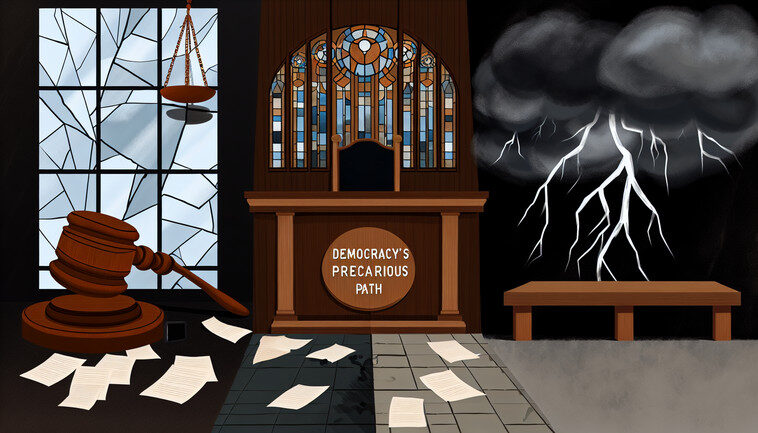
A Judge’s Resignation Rings Alarms: Democracy’s Precarious Path
In an unexpected move that has reverberated throughout legal and political circles, Judge Mark L. Wolf recently made the significant decision to step down from his long-held federal bench. His departure, however, is layered with a gripping warning about the current state of American democracy, explicitly naming former President Donald Trump as a unique threat. Judge Wolf, who began his storied judicial career with an appointment during the Reagan era, has watched the unfolding political theatre with mounting concerns that ultimately led to his dramatic resignation.
Judge Wolf’s warning, visible in his publicly shared essay, is rooted in decades of observation and firsthand experience within the judiciary. With a legacy intertwined with the ebbs and flows of American political and legal developments, his cautions should not be taken lightly. What makes his warning singularly potent is the combination of his judicial insight and the independence of his actions—resigning as a judge doesn’t merely speak volumes, it thunders across the political landscape.
The core of Judge Wolf’s message is about what he perceives as an ‘existential threat to democracy.’ This phrase isn’t just loaded with dramatic flair; it encapsulates a concern that the foundational structures and principles of American governance could be compromised under the weight of divisive leadership. In particular, Wolf underscores the potential erosion of judicial independence, an institutional bedrock that ensures balanced governance and protects freedoms and justice.
Trump’s controversial approach to governance, which often includes challenging norms and pressing the boundaries of executive power, has prompted various responses from both supporters and critics. Judge Wolf’s resignation adds a new dimension to these discussions, aligning with broader concerns about democratic resilience and integrity in an era marked by polarizing rhetoric and unprecedented political maneuvers.
While some might dismiss Wolf’s actions as partisan, his career suggests a deeper motivation—perhaps a plea for a collective reevaluation and rejuvenation of democratic ideals. His position outside the spotlight of partisan politics supports an authentic concern over Trump’s approach and a call to action for those who hold democracy’s principles sacred.
Furthermore, this episode serves as a broader reminder about the fragility of the systems that hold our society together. It prompts questions about the checks and balances designed to prevent any one branch of government from overpowering the others. In times of polarization, the voices that bridge history and contemporary challenges—like that of Wolf—are crucial to ensuring thoughtful dialogue continues to shape a more resilient future.
As Wolf steps back from the bench, his message looms large: The true test of democracy lies not only in its ability to endure, but in its capacity to evolve and adapt in the face of threats. By reflecting on Judge Wolf’s resignation and the points raised in his essay, perhaps we can reignite a collective commitment to safeguarding the democratic architecture that forms the backbone of our nation.

Related Posts