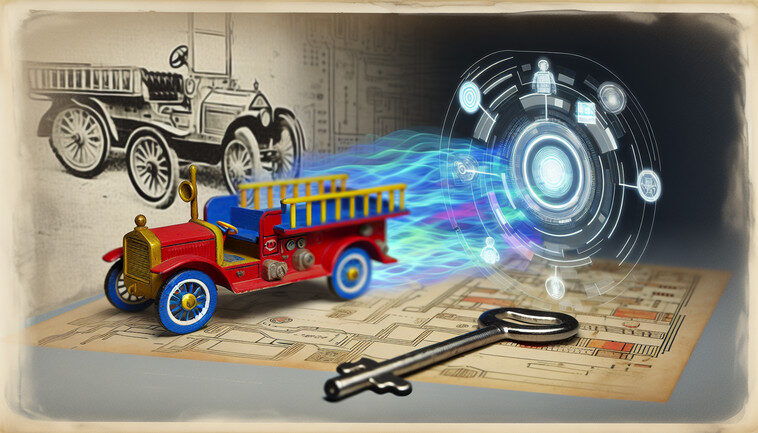
Unlocking the Secrets of a Toy Fire Truck with Modern Tech
In today’s age of rapid technological advancement, it’s not surprising that everyday objects become subjects of digital exploration. The marriage of vintage play and futuristic tech takes center stage when someone decides to delve into the inner workings of something as innocuous as a toy fire truck using radio technology. This intriguing investigation into the unseen world around us captures the ingenuity that resides in the curious minds of tech enthusiasts.
Recently, an interesting experiment caught the attention of technology and hobby enthusiasts alike. Using a seemingly simple remote-controlled toy fire truck, an inquisitive individual armed with a software-defined radio (RTL SDR) set out on a mini-exploration. The goal? To decode and understand the signals that control this miniature fire engine without consulting any instruction manual or internal schematic.
Reverse engineering, at its core, is about unraveling the unknown. In this context, the task involved deciphering the mysteries of how a remote controls a toy vehicle. The RTL SDR tool provides a perfect setup for this kind of exploration. Often used for receiving radio signals, it becomes a bridge between visible actions and invisible processes, offering insights into the communication that occurs within the radio frequency (RF) spectrum.
As the exploration commenced, the intriguing dance of signals was captured. Each button press on the remote had its own specific frequency or pattern, a symphony of invisible waves orchestrating the toy truck’s movements. With an ear to the ground, or rather, an antenna to the airwaves, the investigator painstakingly mapped out these interactions, building a digital blueprint of the toy’s invisible commands.
Beyond its technical aspects, this journey is a testament to human curiosity and the relentless pursuit of knowledge. Through careful observation and analysis, the once-mystical operations of a child’s toy became understandable terrain. This blend of play and science not only fosters a deeper understanding of technology but also sparks inspiration for others to engage in similar explorations.
What makes this endeavor particularly compelling is how it bridges generational divides. It draws parallels between the tactile, hands-on experiences of toy play and the abstract, binary world of digital signals. For many, it’s a reminder of the joy that can be found in the fusion of disciplines, illustrating that technology can enrich even the simplest of pleasures.
In conclusion, this exploration isn’t just about understanding how a toy functions; it represents the broader narrative of how technology can democratize knowledge, turning the complex into the comprehensible. By uncovering the relationships between radio waves and their tangible outcomes, enthusiasts are not only learning but also laying the groundwork for innovations in fields they might not have considered. Truly, in the world of reverse engineering, even the most humble beginnings can lead to groundbreaking revelations.

Related Posts